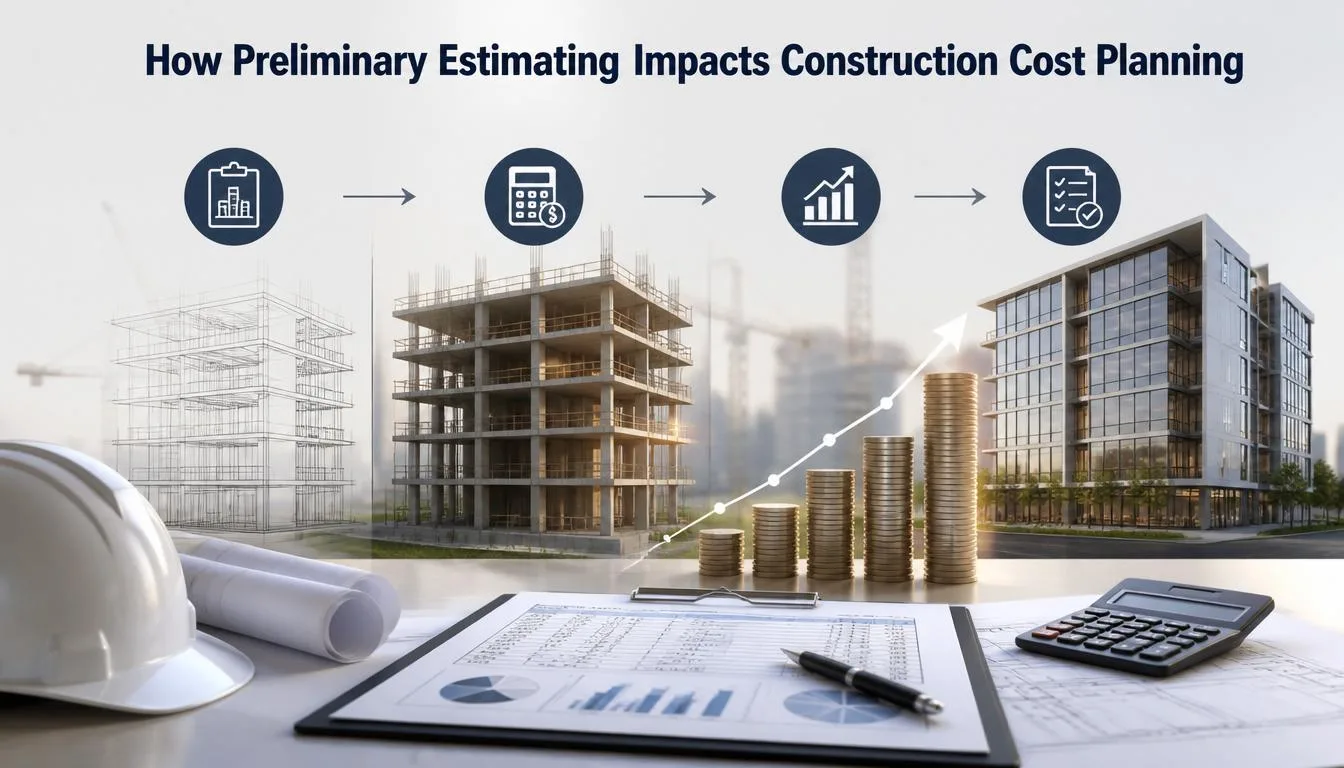
From start to finish, every aspect of a construction project must receive proper financial consideration. Before the completion of the design and before detailed drawings are created, project owners need something more than just a ballpark figure of construction costs. Making decisions without adequate cost information exposes the project to risks, delays, and cost overruns. To avoid these issues, the cost of the project must be estimated. Preliminary Estimating makes it possible to give a project cost estimate in advance of the project. This, in turn, allows project stakeholders to make better decisions and understand the limitations of finance when creating a project budget.
Defining Preliminary Estimating
During the conceptual phase or the early stages of project design, the Preliminary Estimating process enables the estimation of construction costs. Even when details of the construction project are lacking, project owners, developers, and contractors require estimated construction costs for the construction project to be economically viable. Estimators provide these figures to planning and budgeting decision-makers by employing tools such as historical data, benchmarks from the construction industry, and project scope.
Importance of Cost Forecasting
The most important component of a successful construction project is accurate financial planning. When project teams are able to estimate costs, the project goals are able to be matched with funding in order to mitigate financial surprises that are inevitably cost prohibitive. Furthermore, better financial planning enables project teams to mitigate potential budget problems before money has been wasted on the project. Most importantly, proper financial planning enables project stakeholders to modify project scope and design.
Key Advantages of Early Stage Cost Estimation:
Assists in developing realistic budgets
Determines project viability
Mitigates financial exposure
Enhances funding and investment choices
Guides risk management
Optimizes planning
Enhancing Choices in Design Development
While developing design concepts, architects and engineers rely on cost information to make decisions. Cost estimates enable teams to analyze design options, understanding the cost implications of each. Stakeholders utilize Preliminary Estimating to make trade-offs among competing needs within the financial constraints of a project.
Combating Budget Overruns
Budget overruns are a common occurrence in construction. If costs are not assessed in the early stages, the project will incur unexpected costs. Preliminary costing helps to identify financial constraints early in the project lifecycle. This helps project teams to manage costs throughout construction.
Facilitating Funding and Investment
Most construction projects require funding, investment, or the support of decision-makers to continue. Stakeholders want to see realistic estimates to support funding. Construction projects with well-defined budgets are more likely to get funding than projects without clear budgets. Early Estimation is an essential part of the funding and approval process.
Enhancing Communication Among Stakeholders
Construction projects span multiple stakeholders, including owners, designers, contractors, consultants, and financiers. Providing comprehensive cost information guides all stakeholders through the project’s financials. Approximating the project budget fosters clearer lines of communication and diminishes miscommunication. This approach assists the project stakeholders in planning the project and making better decisions during the project’s execution.
Conclusion
The foundation of all successful construction projects is effective cost planning. Stakeholders can assess the project’s feasibility and related risks, as well as the potential funding opportunities, and make better design decisions during the construction process based on the results of an early-stage cost analysis. Construction-related activities can be planned and scheduled proactively based on risk and cost mitigation strategies. Flexible project planning can be accomplished, and the likelihood of achieving the project goals and objectives, including the completion of the construction process on time and within the financial funding limitations, can be significantly increased.